-
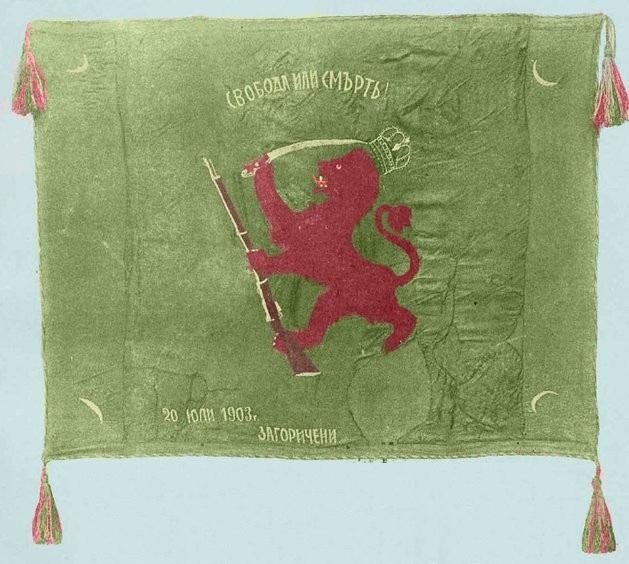
We have points of reference from the late-19th and early-20th centuries which provide us with "types". There are, as I said, examples of a black lion on a red backdrop and I'm aware of ones with a green backdrop (used seemingly exclusively by Bulgars) but the lion is always gold. My sleuthing skills could just be poor and I haven't come across an example of a red lion on a green flag as yet. -
It wasn't my intention to insinuate anything but to deal with the evidence matter-of-factly and postulate what is more likely. And I would retort that it's your insinuation that the image is a colourisation of a monochromatic image based on the original colour scheme for which you have no proof only conjecture which is truly silly. Either the colourised flag is a product of Bulgar fantasising or the vectorised flag and the real-life example I provided a product of Macedonian fantasising. Pick one.Leave a comment:
-
You raise some good points, and at least you found the person behind the colorization. But I'm not entirely convinced yet on the color scheme.
It shouldn't come as a surprise to anyone if red and green was the color scheme, look at Apostol Petkov's flag from Enidze-Vardar, it was half green and half red. So let's not play silly games and imply that if it was green it some how makes it less Macedonian.
Sofia already has a large collection of original Macedonian flags, perhaps the Zagorichani flag is on display in one of their museums. That would be the only way to confirm.
Apostol Petkov's flag:


Leave a comment:
-
As a follow-up to my last post: after a bit of research I am certain that the colourised image above is another Bulgar forgery. I found a site which has a vectorised version of the flag in question here. The vector image has a red background with a black lion which, based on the preponderance of such flags, I believe is a more accurate representation of the flag's original colour.
Moreover, in the comment section of that site, a Bulgar has made the assertion that the "original" flag colour is green; the lion red, and that "no one draws a black lion" (translated from Bulgar), no doubt referring to the colourised image. This statement is of course false since the flag of the Razlovtsi Uprising also has a black lion on a red backdrop. The Bulgar also claims that the text is white, but in the colourised image one can see that the green saturation is overlayed even on the "white text" (evidently cutting corners). But the most damning of all is that the Bulgar actually links to the potential source of this manipulation, another Bulgar on Facebook who colourises old photographs. He is then duly called out on it in the reply.
To top it all of, here is a real-life reconstruction of the flag that I found. I wonder what their point of reference was...

Leave a comment:
-
Thе flag looks typical of a photo that has undergone colorisation as opposed to decolorisation. The washed out colours not withstanding, there are red and green artefacts extending beyond the tassels themselves which, in my opinion, are not attributable to noise. The inconsistency is most noticeable in the colorisation of the top right tassel when compared to the decolorised image and even the shape of the bottom right tassel is is different in both images.Originally posted by Liberator of Makedonija View PostLeave a comment:
-
That colour pattern raises questions for me.Originally posted by Niko777 View PostLeave a comment:
-
Yes you have it completely right. Most Macedonians I've talked to don't know that on August 2nd it's actually July 20 on the Macedonian Orthodox Calendar. And they don't know that when Ilinden took place, it was July 20th to them, the Ilindenci.Originally posted by Soldier of Macedon View PostLeave a comment:
-
I'm no expert either but, if I was to hazard a guess, I think it has something to do with the communist atheist ideology of the time (i.e. in 1944/45) who, on the one hand, felt the need to commemorate the Macedonian people's uprising against the Turks and, on the other, break all ties with the Orthodox church. The modern equivalent of the Orthodox calendar date for Ilinden, 2nd of August, commemorates the Ilinden Uprising without tying it to the Orthodox Church. That's my take on it anyway.
Would it be better to go the way of Ovcharani and other Aegean Macedonian villages who celebrate Ilinden on 20th of July?...I'm not sure but I wouldn't be opposed to it ether way.Leave a comment:
-
Just to clarify something about the 'real' date. The Gregorian calendar, which is what modern states use today, leaps forward from the original Julian calendar (which is approximately 1,600 years older) by almost two weeks. In Ottoman times, which is when this flag was made, we used the Julian calendar exclusively. Our church today still does for actual religious dates, but it superficially applies the Gregorian calendar dates. For instance, we still celebrate Ilinden on 20 July according to the Julian calendar, but on the same day it is 2 August in the Gregorian calendar. Same for Christmas, we celebrate it on 25 December according to the Julian calendar but on the same day it is 7 January in the Gregorian calendar. This is why I find it a little odd that our people in Ovčarani celebrate Ilinden on 20 July of the Gregorian calendar, because it's about two weeks earlier than the actual date according to the Julian calendar used by Orthodox Christians (including Macedonians during the Ilinden Uprising and prior to the usurpation of their lands by the Greek state). This is my understanding. I'm not an expert on this topic so if I have mistaken something anybody can feel free to correct it.Originally posted by Niko777 View PostLeave a comment:
-
Do you know if thats the original colouring or a recolour?Originally posted by Niko777 View PostLeave a comment:
-
Flag of the Ohrid četa


Flag of the Struga četa

Flag from Zagoričani (Kostursko) during the time of the Ilinden Uprising
 Last edited by Liberator of Makedonija; 07-01-2018, 09:50 AM.
Leave a comment:
-
Flags/Banners of Macedonia
Thought this forum could use a thread dedicated to flags and banners used by us Macedonians, especially those of četi from years gone by.
I'll start off simple:
Flag of the Kruševo četa during the Ilinden Uprising, also the flag of the Kruševo Republic

 Last edited by Liberator of Makedonija; 07-01-2018, 05:13 AM.

Leave a comment: